Market outlook, December 2025 - The AI theme is heating up
November has been a turbulent month in the stock markets. A weak start was, however, replaced by a significant recovery, and the monthly development in the major markets ended mostly flat.

What happened in November?

The shutdown of the American government is finally over. There is still a backlog in the delivery of many macro indicators. We therefore place great emphasis on signals from the companies' earnings season.
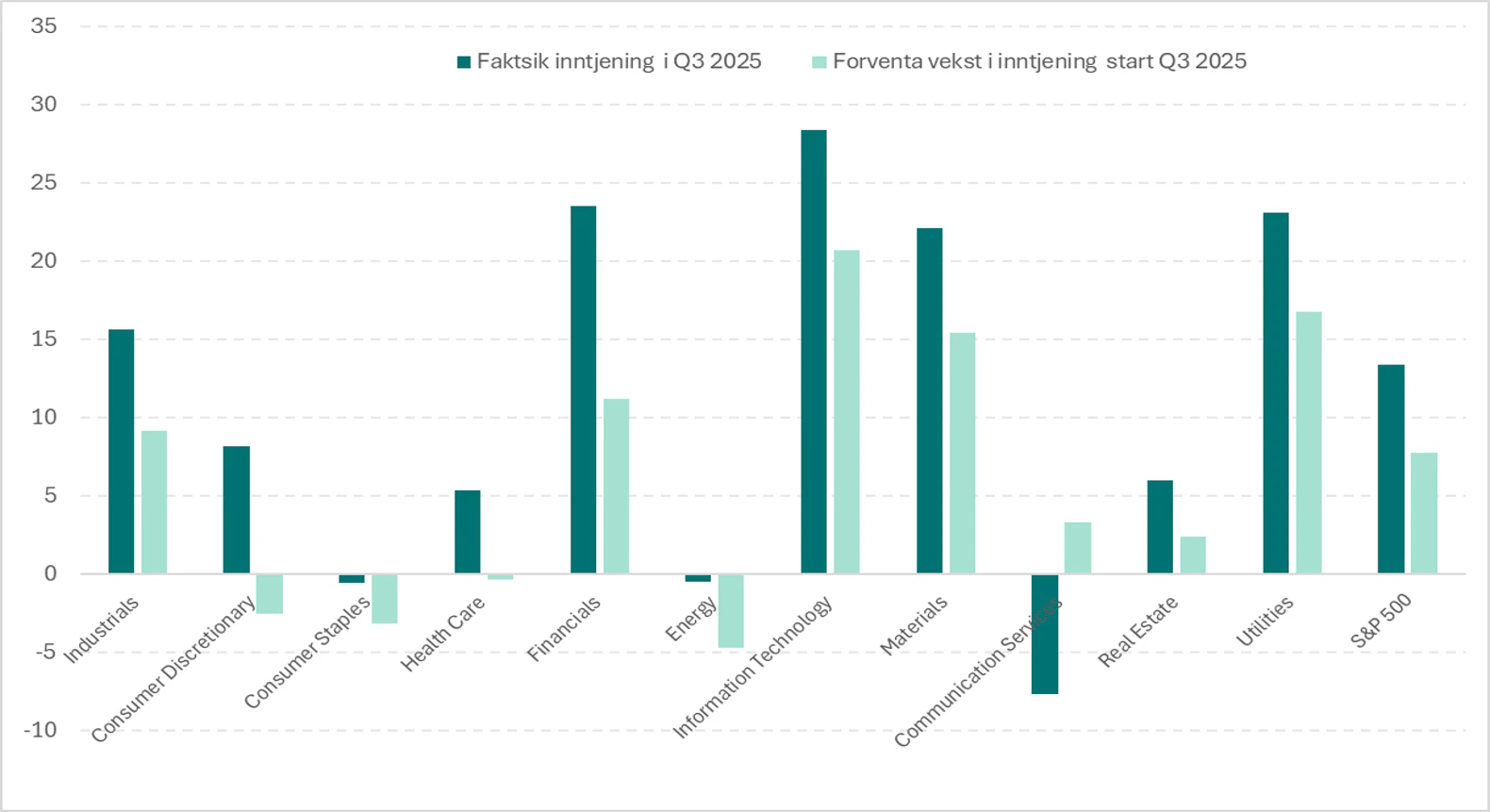
Overall, companies are delivering good results and expectations for future earnings. Together with our belief in a few more American interest rate cuts, this should provide a good backdrop for risky assets. The uncertainty relates to valuation at the high end, and to the massive investment appetite related to the AI theme. We therefore maintain a near-neutral equity weight in the portfolios.
Faltering narrative around AI?
The market correction at the beginning of November had the strongest impact on companies in the technology sector. Nasdaq was down as much as about seven percent at its lowest. Whether this is merely normal fluctuations or signs that the markets are increasingly seeing structural weaknesses within the AI theme is difficult to say for sure.
Some conflicting signals regarding further interest rate cuts from the American central bank may explain the short-term market changes in November. Lower interest rates are of course positive; however, we are skeptical that one interest rate cut or the other is leading for the development of these companies.
It is clear that it is the AI theme that has driven the stock market over the past three years. It is also likely that the use of AI has the potential to yield significant productivity gains. In many fields, it could also contribute to changing entire business models and fundamentally alter the need for labor.
In recent months, however, more and more people have raised questions about the enormous investments made around AI models and related infrastructure. Simply put, we believe the question is not whether AI has the right to exist, but whether it is possible to justify the investments that have been made.
To justify current pricing, companies should deliver the same return on AI-related projects as they had on existing operations. How the world will look five years from now is impossible to predict. Perhaps we will have one or two "AI winners" that end up with monopolistic pricing power. Or we may have an AI world without competitive advantages, where AI gains contribute more to societal economic benefits.
We have an overweight in the technology sector in our portfolios.
Some points on how we play this related to the risk of overinvestment and bubble pricing:
- Regarding the Mag7 companies, we have an exposure that is overall close to the benchmark. However, we are somewhat more positive towards the large hyperscalers. These have existing business models and revenue streams that allow the "AI capacity" built to be utilized for existing operations in case the narrative around AI fades. Over time, these companies may grow into potentially overinvested capacity.
- We are underweight the more one-dimensional players that are more directly linked to the AI theme, for example, as suppliers. If investments fall, these are noticeably more exposed.
- There are signs that companies are becoming increasingly confident about a sustained productivity increase associated with the use of AI. This leads to layoffs/stopping of new hires, which positively contributes to the companies' margins. This is obviously not entirely positive, as it can have implications for the labor market and the economy in general.
K-shaped economy
The earnings season for American companies was generally good. Where the clearest signs of weakness were seen was within the consumer-oriented sectors. Companies in the necessities sector are experiencing margin pressure, indicating that they are not able to pass increased costs on to consumers. This is largely linked to the fact that consumers in the lower income segments are, and have been, under pressure. Despite this, the American economy and consumption have held up well. The explanation is what economists call a "K-shaped" economy. It reflects the difference in economic robustness between income groups. Low-income groups are increasingly suffering, while the wealthier have increased purchasing power and contribute to keeping consumption up.
Also for companies related to discretionary consumption, there are early signs of weakness. However, there are larger differences across industries. Wealthy consumers continue to spend money on travel and experiences, while cutting back on cars, furniture, and durable household items. So far, there are not clear enough signs that the wealthy are cutting consumption significantly enough to risk pushing the economy into recession. However, it will be important to follow the development of this consumer group, especially if developments in AI lead to further downsizing of the workforce. So far, it is the case that the wealthy often hold the jobs that are most at risk of being replaced by AI initiatives.
The portfolio
No changes in market outlook from last month.
- Near neutral weight in equities.
- Overweight bonds vs. Money market.
- Overweight high yield, mainly in the form of Nordic exposure.
