Why is a low risk equity portfolio such a great idea?
Low risk portfolios are outperforming broad market indexes. How can that be? What happened to the “truth” of high risk, high reward in the stock market?

If it’s true, that risk adjusted portfolios perform better than most index portfolios in the long run, why do investors invest their long term savings according to these benchmarks? Shouldn’t a long term investor always be optimizing the risk adjusted return (or Sharpe ratio) of their portfolio?
Have investors been lured to think that index funds is the best choice?
Minimum volatility portfolios shocked the finance world 25 years ago
25 years ago I started my career as a quantitative portfolio manager. Around that time, articles were published by Professor Robert A. (Bob) Haugen and his colleague, Nardin L. Baker. The two professors had used Markowitz’ optimisation models to follow the performance of minimum volatility portfolios in the US.
They came to the rather shocking result that these portfolios were outperforming the more traditional stock portfolios. Nobody believed their findings to be generally true, as modern finance theory relied on markets to award risk with higher returns.
20 years of experience beating the broad indexes
Only days after joining a major asset manager in Oslo, I contacted Bob Haugen and Nardin Baker.
This has turned into more than 20 years of cooperation.
We started running global core portfolios, and witnessed how low risk stocks continue to outperform. It took almost 15 years until investors were ready to trust the research, and bet money on what was called “the low risk anomaly” in the equity markets.
Morgan Stanley Capital International then started a global minimum volatility index (MSCI MV), and quantitative portfolio managers started rolling out products.
Our first client, located in Tokyo, realised a 40 % risk reduction compared to the MSCI World Index over a five year period, with annual returns beating the broad index.
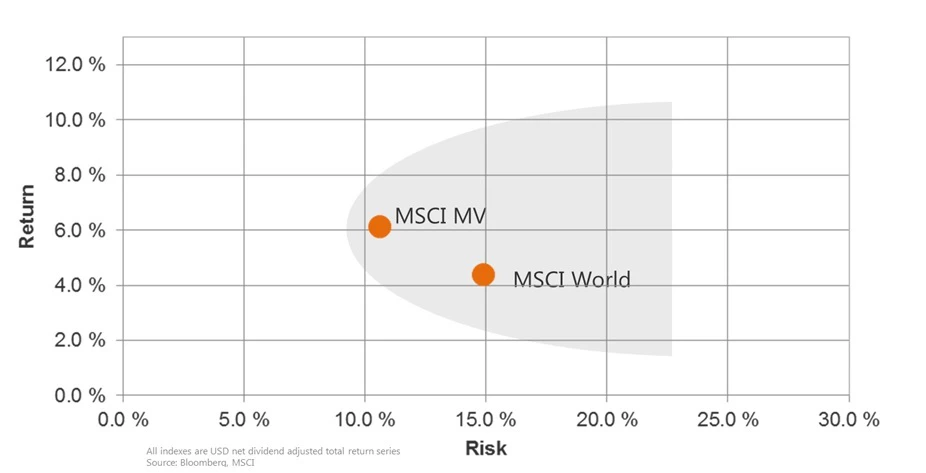
LOW RISK, HIGHER RETURN: 20 years of observed data (1999 -2018) show that the MSCI Minimum Volatility Index beat MSCI World by nearly two per cent and at a much lower risk. (Source: Bloomberg/MSCI)
I think it’s about time to ask the rhetorical question: What if pension funds generally are invested in equities that have too high risk?
There is clearly a possibility that many pension funds could have much higher equity exposure if they owned Minimum Volatility portfolios, netting higher returns while realizing the same risk, or even at a lower risk?
Why haven’t more investors heard of this?
The theory behind low volatility portfolios have been explained by others before. So why isn’t this way of building portfolios more popular?
The graphics below summarize some of the suggested drivers behind the low risk anomaly.
My personal favourite explanation is the “Agency Problems”. In our business portfolio managers, analysts and traders are generally awarded bonuses for extraordinary high performance.
Now, think of a situation where a portfolio manager can choose between letting a low risk stock and a high risk stock enter her portfolio. Constructing the portfolio with low risk stocks means that the portfolio return is not very likely to bring bonuses. It will become a steady provider of strong equity returns, but that bonus for high Information Ratio (IR) measured results will just not happen.

EXPLANATORY MODEL: There are many reasons why a minimum volatility portfolio wins in the long run, this model show the factors that influence the result.
The higher risk approach will bring that occasional big bonus, whilst that average performance over time will suffer. I think there are such agency problems, not only among portfolio managers, but for most people involved in pricing stocks. Such behaviour makes the high risk stocks more popular than their returns justify. They are attractive for their option-like returns. The extra attention works like in all other markets. Attractive goods are priced higher, but in this case, research show that this means lower returns over time. Low risk wins.
Disclaimer: Nothing contained on this website constitutes investment advice, or other advice, nor is anything on this website a recommendation to invest in our Funds, any security, or any other instrument. The funds mentioned may not be available in the markets you represent. The information on this blog is posted solely on the basis of sharing insight to make our readers capable of making their own investment decisions. Should you have any queries about the investment funds or markets referred to on this website, you should contact your financial adviser.